Rough, pure and universal – About the Budapest gig of VOŁOSI
I could write phrases like ’unique’ or ’original’, but it just would not be good enough to describe what I felt last night. VOŁOSI is the pure essence of string-orchestra, authentic and progressive, classical and folk, delicate and raw at the same time. This kind of mixture is not new at all, world music projects usually own this crossover approach. However, the Polish string quintet embraces the two worlds in a symbiosis that effects the audience so elementary, which is very rare to find. Critic.
MÁRTI MÉNES – 061.hu
On Saturday, VOŁOSI played in the famous folk music and dance venue in Budapest called „Fonó Budai Zeneház” as part of the 9th „Wine and Violin” Violin Makers’ Salon. The band has been known by wider Hungarian audience since their album made in cooperation with Félix Lajkó, which was chosen in the Top 10 last year by the British Songlines, the most prestigious review of world music. Being on the list of Best Albums of the Year is a thing – this record was the only one which could make it from the ones released in Hungary in 2019. The album was in Top 3 for two months in World Music Charts Europe, and it was highly appreciated by Transglobal World Music Charts and region-specific Balkan World Music Charts.

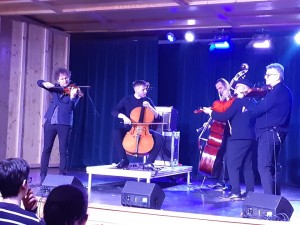
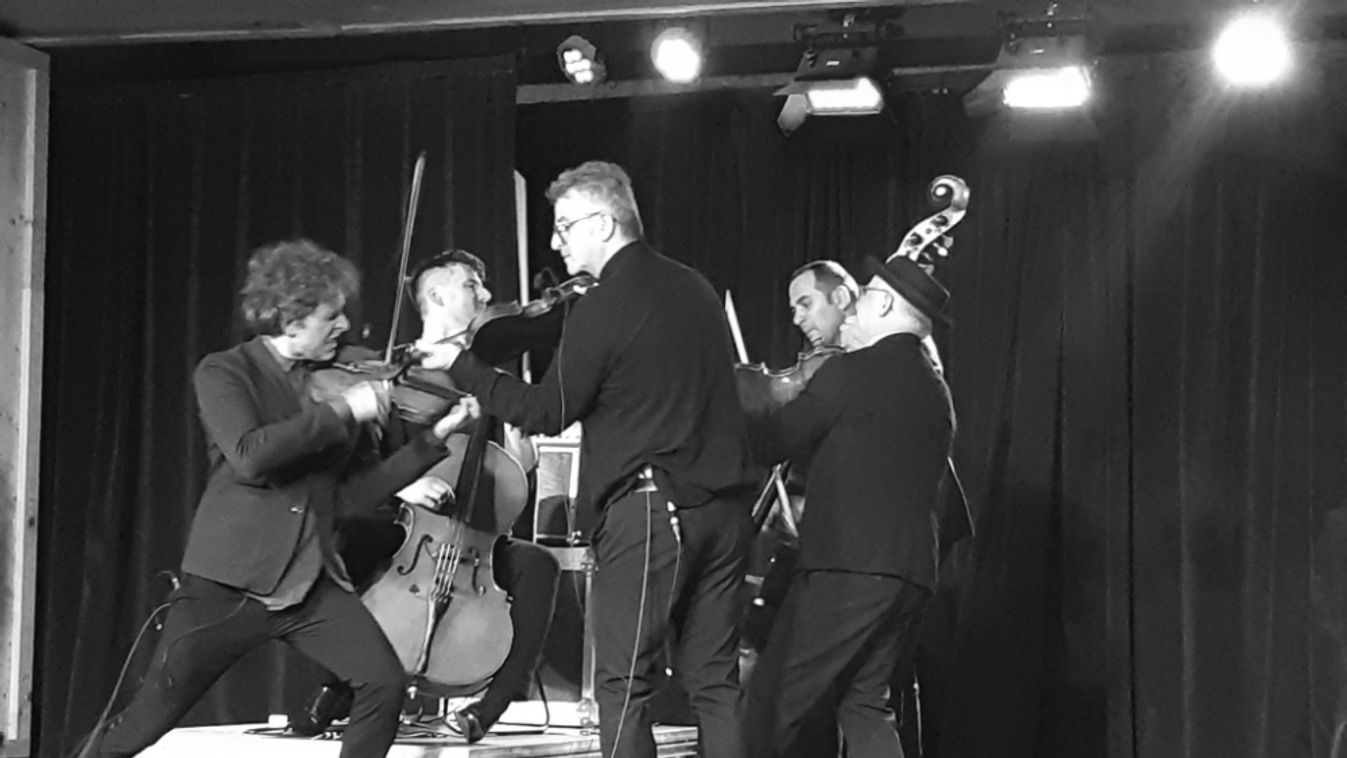
The Polish string band is a true star in the world music scene. They are often referred to as „rockstars of the strings” because with two violins, a viola, a cello and a double bass they are able to rock the stage the same as a metal band with distorted guitars and drums. Béla Szilárd Jávorszky wrote in his book The history of Hungarian folk about the first folk dance-house which was free to public – organized in February 1973 in the Metropolitan Community Centre – that „nobody thought that the attendance would be comparable to rock show standards, with queuing at the entrance, getting in through the toilet window, scuffling, clashing and breaking glass. Police cars using sirens rushed there on and off because twice as much people tried to get in as the place could host.” When listening to VOŁOSI I wonder if this kind of music could sweep over again as a hurricane and re-define the position of our often-forgotten cultural heritage among urban youngsters by establishing tradition. Beyond that folk music is the most genuine form of self-expression, a deep-rooted rough, pure and universal language, it is obvious that Polish and Hungarian folk music have a lot in common. It was clearly proved by the cooperation of Félix Lajkó and VOŁOSI, where the musical ideas of the two were fading into each other super-smoothly. String music traditions of Eastern-European folk music are familiar to both countries, melodies are also alike and the skills of the musicians bring us even closer to feel perfection.
The band members are classical musician brothers Krzysztof Lasoń (violin) and Stanislaw Lasoń (cello), and three folk musicians, Zbigniew Michalek (violin), Robert Waszut (double bass) and Jan Kaczmarzyk (viola). They play with unlimited power and inexhaustible improvisation, and the individuality of their music comes from the rebirth of classical sounds by dissolving in rough tones. Just like Félix Lajkó, VOŁOSI is not afraid of going beyond comfort music and they realize the full potential of their instruments. They do this in such a harmony and on such an expert level that the audience forgets to breath while watching them. In Fonó, they received standing ovation.
The Polish strings use contemporary, folk and jazz bases with a deliberate concept, by giving space for all five of them. The Lasoń-borthers greatly enjoy being the instinctive musicians crossing over musical genres, and as they are stepping more and more closely to each other during the performance of a musical dialogue, one can experience the inward and inspiring medium they are living in.
This is a virtuoso music of joy, music of the Carpathians, that goes deep inside our souls and makes us believe that folk music is cool.